The Inducement Concept (IDM)
Inducement, abbreviated as IDM, is the trap Smart Money sets to lure retail traders into entering a position early. It usually looks like a clean breakout or a textbook pullback, but its only purpose is to harvest stops before price reaches the real institutional zone.
Identifying the First Internal Pullback
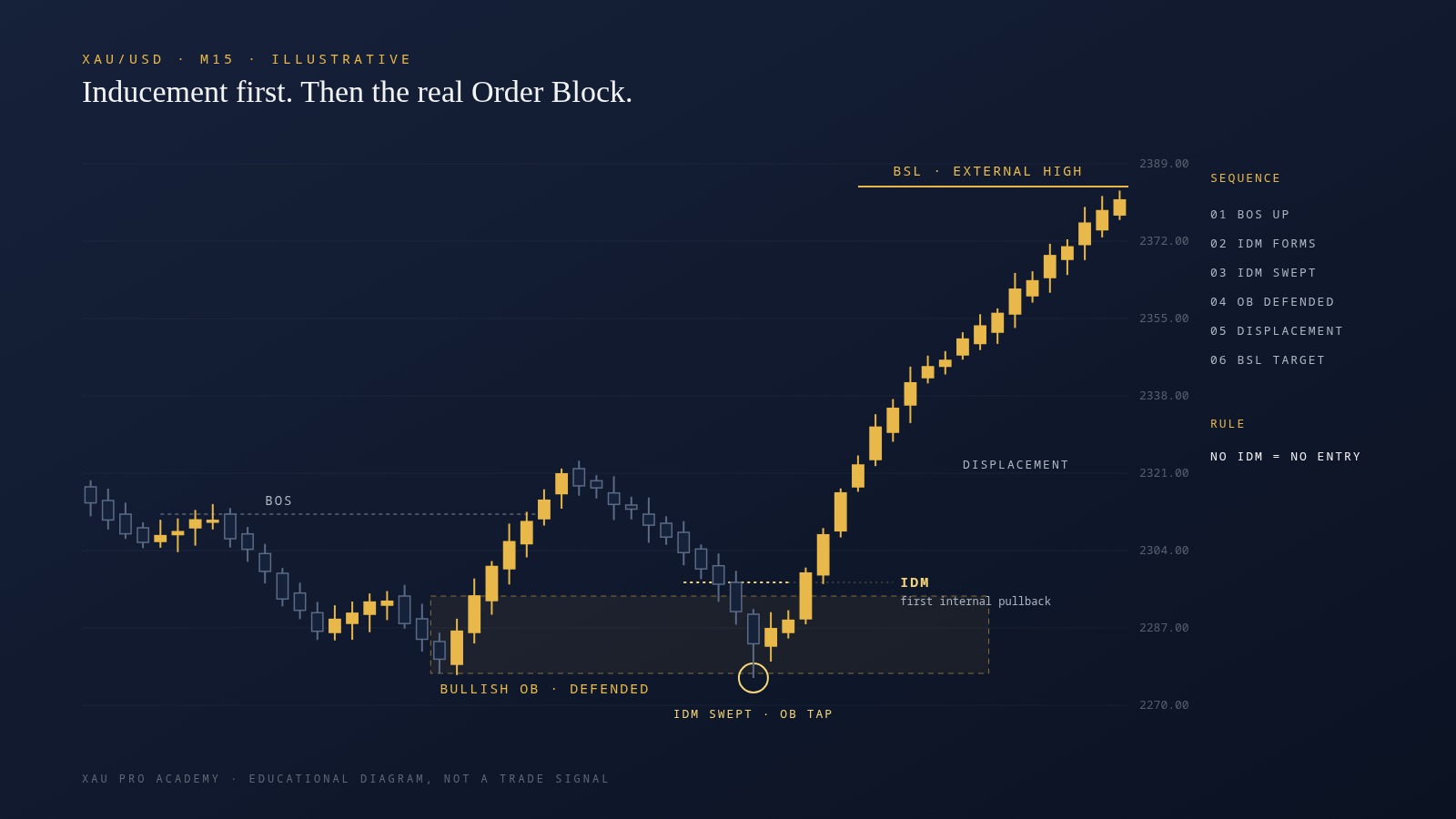
After a Break of Structure (BOS), price almost never runs cleanly to the next target. Instead, it leaves a small internal pullback, a minor high in a bearish leg, or a minor low in a bullish leg. That pullback is the inducement.
Retail traders see the BOS, anticipate continuation, and place orders at the pullback. Smart Money sweeps that pullback first, collects the stops, and only then drives price into its true Order Block or FVG.
The Golden Rule: No IDM = No Entry
A valid Order Block must have inducement sitting between it and the current price. If there is no IDM to be swept, the Order Block is statistically far less likely to hold. Smart Money has no incentive to defend a level that hasn't generated fresh liquidity.
Filtering Low-Probability Order Blocks
Use this 3-question filter on every potential Order Block:
- Is there visible inducement (a minor pullback) above/below it?
- Has that inducement been swept before price reaches the OB?
- Is the OB origin candle followed by displacement that creates an FVG?
If any answer is "no," skip the trade. You will pass on a few good setups, but you will eliminate the majority of losing ones.
XAU/USD Example: Order Block + IDM Sweep
Wrap-Up
Inducement is the difference between an A+ setup and a "looks-good" setup. Once you start demanding an IDM sweep before every entry, your win rate and your discipline both go up. Mark this lesson complete when you can spot inducement on a live XAU/USD chart in under ten seconds.