Gold Trading Sessions: Timing Is Context, Not a Signal
The London open and the London and New York overlap are useful windows to observe XAU/USD liquidity and price discovery. They are not automatic entry windows. An active session can produce continuation, a failed breakout, or no qualified trade at all. The best time to trade gold is therefore the intersection of session participation, confirmed structure, manageable execution costs and acceptable news risk.
This guide separates market hours from discretionary liquidity analysis. Use the live gold trading sessions clock for local-time conversion and event markers. Use the framework below to decide what the price action actually confirms. The examples are educational, not live signals or a disclosure of Orion's internal execution policy.
XAUUSD Session Hours and Liquidity Windows
Spot gold is an over-the-counter market, not a single exchange with one opening bell. The LBMA describes Loco London as a global OTC market operating around the clock. Retail XAUUSD access still depends on the broker's dealing hours, maintenance breaks and holiday schedule. CME gold futures are a separate exchange-traded product with nearly 24-hour electronic access. Their contract specifications and prices must not be treated as interchangeable with spot lots.
The following are the observation conventions used by our session clock, not official spot-gold exchange hours. “London open” means a local dealing window; “New York open” means the start of the clock's New York session, not the US equity opening bell.
| Window | Local convention | UTC reference | Observation |
|---|---|---|---|
| Asian (Tokyo) | 09:00 to 18:00 Tokyo | 00:00 to 09:00 all year | Range boundaries or an existing trend |
| London opening window | 08:00 to 11:00 London | 07:00 to 10:00 BST; 08:00 to 11:00 GMT | Reaction at overnight liquidity |
| London / New York overlap | 08:00 New York to 17:00 London | 12:00 to 16:00 in aligned summer; 13:00 to 17:00 in aligned winter | Continuation, reversal confirmation and US news risk |
| New York afternoon | 17:00 London to 17:00 New York | 16:00 to 21:00 in aligned summer; 17:00 to 22:00 in aligned winter | Manage exposure and check rollover conditions |
These labels do not establish a measured volatility ranking or guarantee tighter spreads. Compare the quoted spread, recent candle ranges and actual fills on your own venue. A large candle indicates movement, not necessarily deep liquidity or reliable execution.
Daylight Saving: Why Fixed UTC Kill Zones Drift
The UK changes clocks on the last Sundays of March and October. The US changes clocks on the second Sunday of March and the first Sunday of November. During the mismatch weeks, London is four hours ahead of New York rather than the usual five. Under the convention above, the overlap becomes 12:00 to 17:00 UTC.
For example, in 2026 the US changes on March 8 and November 1; the UK changes on March 29 and October 25. A saved UTC screenshot is not a permanent calendar. Anchor London events to Europe/London and US releases to America/New_York. “Kill zone” is a discretionary trading label, not an exchange-defined period or evidence that an edge exists. Specify the time zone whenever you use it.
The Asian Session: Build a Map Without Assuming a Range
First identify whether the overnight market is balanced or directional. In a balanced market, mark the observed high and low and any repeated swing levels. In a directional market, preserve the trend structure rather than forcing an accumulation label. Asian hours can trend after regional news, geopolitical developments or a repricing carried over from the previous day.
- Define the sampling window. The full Tokyo session overlaps London's opening window. If you trade the London open, freeze your pre-London range at your chosen cutoff; do not retroactively include later Tokyo candles.
- Separate liquidity references. Overnight highs and lows, previous-day extremes and H1/H4 swings need distinct labels. A minor internal level does not replace an external target.
- Record price location. A compressed range inside a higher-timeframe POI differs from a range formed mid-leg without a clear invalidation level.
Stops may cluster beyond visible highs and lows, but a retail chart does not reveal the full OTC order book. These are candidate liquidity references, not proof of institutionally engineered orders. Do not assign a breakout failure rate unless it comes from a defined, reproducible dataset.
London Open: Read the Reaction, Not the First Impulse
London's opening window is a useful time to watch how price behaves around overnight boundaries. A move through a high is not automatically a sell signal; a move through a low is not automatically a buy signal. The first task is to classify the response at the level.
- Rejection candidate: price trades beyond the boundary and returns inside. This is a possible raid, not confirmed reversal.
- Continuation candidate: a candle body closes beyond meaningful structure with visible displacement. Assess whether a subsequent pullback holds the new structure.
- Unresolved interaction: overlapping candles, repeated wicks or a weak close leave the direction uncertain. Keep the bias neutral.
A body close alone is insufficient for a qualified BOS. It needs meaningful structure and displacement. A wick-only break is a liquidity interaction, not BOS. Read the CHoCH and BOS guide for the distinction between a continuation break and an early reversal warning.
Judas Swing on Gold: A False Expansion Requires Confirmation
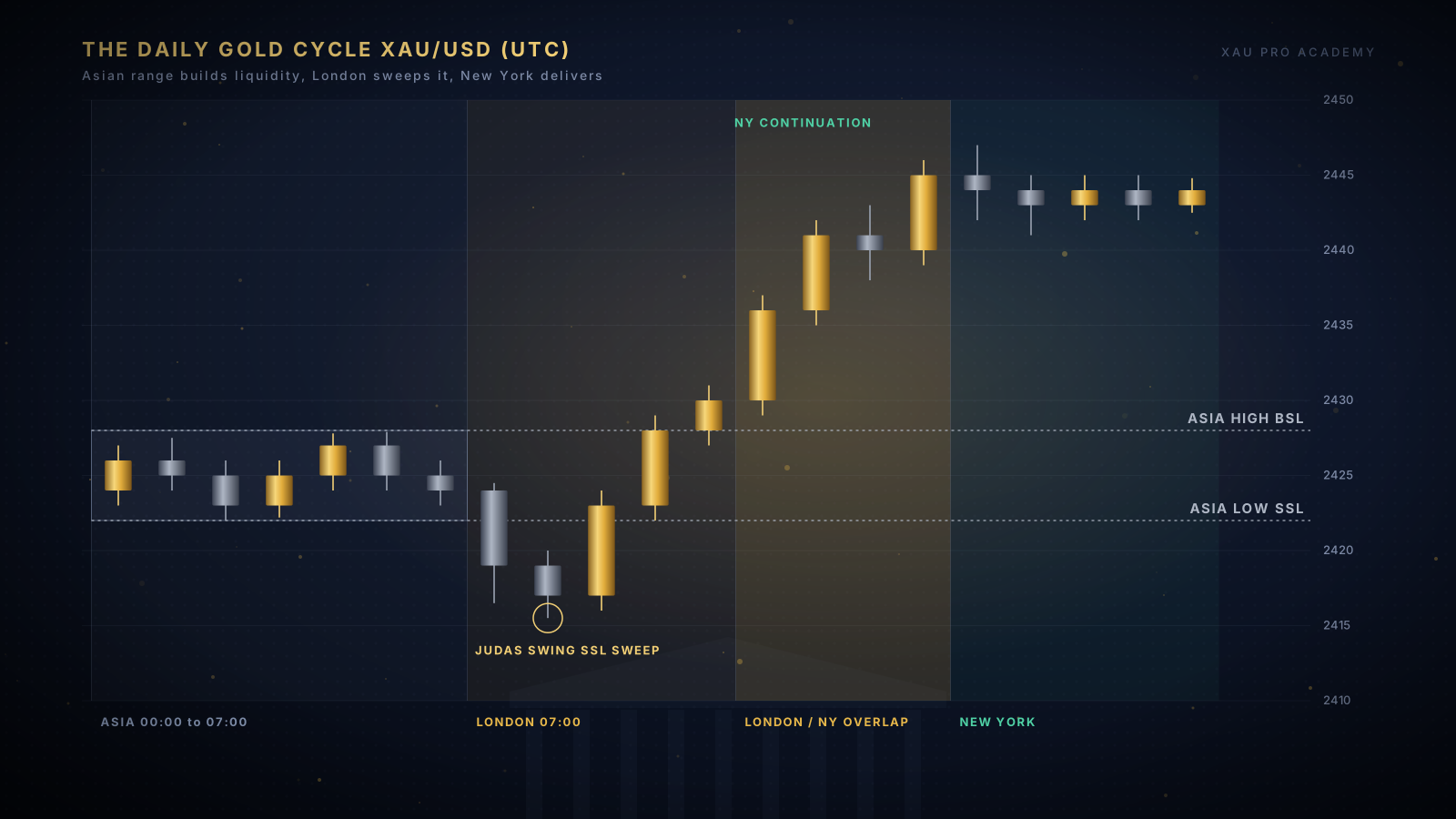
In SMC terminology, a Judas Swing describes a false directional expansion near a session opening window, followed by rejection and a move the other way. It is a retrospective description until the rejection and structural confirmation exist. It does not prove manipulation, reveal who traded, or mean that every London sweep must reverse.
A conditional bullish sequence
- H4 structure supplies context; H1 refines the relevant liquidity and POI. Avoid assuming a long simply because an overnight low exists.
- Price trades below the marked pre-London low and returns inside the range.
- M15 prints upward displacement and a body close through a meaningful internal swing. A weak CHoCH without displacement remains only a warning.
- The displacement creates a qualified, unmitigated FVG or order block. A pullback may offer an entry only if the zone remains valid.
- Define structural invalidation and an opposing liquidity target. Reject the trade if costs and stop distance leave inadequate reward relative to risk.
A bearish sequence reverses those directions: a raid above highs, rejection, downward displacement and a qualified pullback zone. If the higher timeframes strongly oppose the proposed reversal, the setup is counter-trend and high-risk. M15 cannot simply override H1 and H4.
A sweep followed by acceptance outside the old range invalidates the simple reversal narrative. A return inside without displacement leaves it unresolved. The correct response to either is not to force a Judas Swing trade. See the liquidity sweep guide for further context, and require the confirmation conditions described here.
New York and the Overlap: Reassess London's Narrative
New York participation introduces another decision point, not an obligation to execute. If London established confirmed structure, an aligned pullback may support continuation. If London failed outside an overnight boundary, New York may provide opposite displacement. It may also invalidate both interpretations through choppy two-sided trading.
Do not assume New York “delivers the real move.” Compare H1/H4 context with current M15 structure and the distance to the next external liquidity pool. A valid morning idea can become unattractive after expansion consumes its available reward. Passing on a late entry is consistent with capital preservation.
CPI, NFP and News Risk Inside the Session
The BLS schedules CPI and the Employment Situation report, which includes nonfarm payrolls, at 08:30 Eastern Time. That converts to 12:30 UTC during US daylight saving and 13:30 UTC during standard time. Confirm each release on the official BLS calendar; holidays and schedule changes matter. FOMC announcements follow a separate Federal Reserve calendar and should not be grouped under the 08:30 convention.
Around high-impact news, quoted prices, spreads and execution quality can change faster than a chart confirms. A stop defines intended invalidation, not a guaranteed fill. Do not enter the initial spike just because it crosses liquidity. Wait until the spread and price structure are interpretable; a fixed waiting period alone does not prove that conditions have normalized.
Review the CPI and gold tracker and NFP and gold tracker before planning exposure. The clock's event shading is an informational caution window, not a complete representation of live engine policy or proof that trading becomes safe immediately outside it.
Pre-Session Checklist and Hard Rejection Conditions
- Bias: assess H4 first, H1 second. State neutral if the directional structure is unclear.
- Liquidity: mark external swings, previous-day extremes and a consistently defined overnight range.
- Confirmation: require liquidity interaction, displacement and a meaningful structural body close.
- POI: identify the zone created by that displacement. Reject a heavily traded or already mitigated zone.
- Session and macro: check local hours, event risk, venue spreads and holiday conditions.
- Risk: define structural invalidation, costs and target distance before calculating size.
Reject an idea when there is no displacement, no relevant liquidity interaction, unclear structure, a weak reward-to-risk profile or unstable news conditions. Do not tighten the stop merely to manufacture a favorable ratio. Use the gold position size calculator after defining the stop, and check the gold pip value calculator against your broker's contract and pip conventions. Margin available is not risk available.
For funded accounts, check daily drawdown calculations, floating-loss treatment, news restrictions and weekend holding rules. New exposure late Friday or around a broker's daily rollover needs explicit justification because closure, changing spreads and gaps can prevent execution at intended prices.
Conclusion: Observe, Confirm or Stand Aside
The Asian range is a reference, London is a reaction window and New York is an opportunity to reassess. None guarantees a trade. A Judas Swing becomes useful only when rejection is followed by confirmed structure and a qualified POI with acceptable risk. Timing filters an idea; it does not create one.
Start with the live session clock, check which hours currently carry the most range on the XAUUSD volatility heatmap, then apply the gold entry qualification checklist. If the evidence is incomplete, retain a neutral bias and no new exposure.
Sources and Scope
- LBMA: About Loco London. OTC market architecture.
- CME Group: Gold futures. Exchange-traded access and product context.
- BLS release calendar. CPI and Employment Situation timing.
- GOV.UK clock changes and NIST daylight saving rules. Local-time conversion.
Official sources support market architecture and schedules, not the profitability of SMC patterns. Session behavior and the schematic examples are a discretionary educational framework. No sweep frequency, win rate or execution advantage is claimed.