Introduction: The Price You Pay Matters
Two traders take the same bullish setup on gold. One enters at the top of the range, the other waits for a deep pullback. Same direction, same stop logic, completely different outcomes. The difference is not skill. It is where inside the range each one bought.
Premium and Discount zones are the institutional way of answering a simple question: is price currently expensive or cheap relative to the range it is trading in?
Defining Premium and Discount
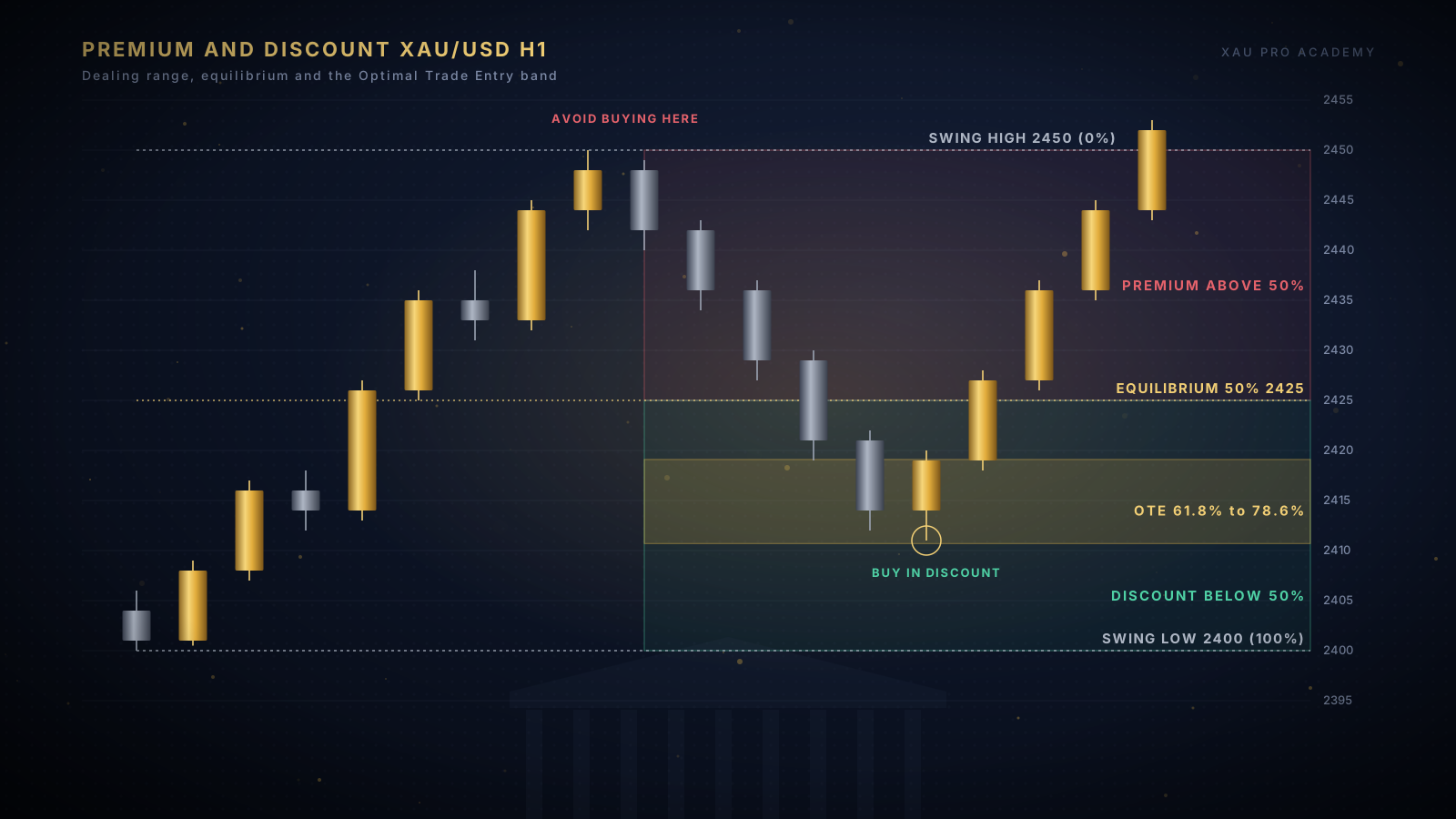
Take any dealing range: a clear swing high and a clear swing low. Split it at the 50% level, the Equilibrium.
- Premium: everything above the 50% midpoint. In a bullish context, buying here means paying full price.
- Discount: everything below the 50% midpoint. In a bullish context, this is where value sits.
- Equilibrium: the midpoint itself, a zone of fair value where the edge is weakest.
The rule mirrors how institutions think: buy at a discount, sell at a premium. A bullish setup taken inside the premium half of the range is a low-quality trade even when the direction is correct.
The Optimal Trade Entry Zone
Within the discount half, the highest-probability band sits between the 50% and 78.6% retracement of the range. This is the classic Optimal Trade Entry area, where institutional re-accumulation most often occurs before continuation.
Our own multi-year research on XAU/USD confirms the principle: entries taken in the deep discount band of the higher-timeframe range produced materially better risk-adjusted results than entries taken near equilibrium or in premium. The zone filters out impulsive entries without reducing opportunity count to zero.
Applying It on XAU/USD
A practical gold workflow:
- Step 1: define the H4 dealing range from the most recent significant swing low to swing high (or the reverse in a bearish leg).
- Step 2: mark equilibrium. Below it is your only area of interest for longs.
- Step 3: inside the discount, look for confluence: an Order Block, a Fair Value Gap, or a Breaker sitting in the 50% to 78.6% band.
- Step 4: wait for a lower-timeframe liquidity sweep into that zone, then execute on the structure shift.
Common Mistakes
- Using the wrong range. Premium and discount are only meaningful relative to a valid, recent dealing range. Measuring from random swings produces random zones.
- Treating equilibrium as an entry. The midpoint is where win rate and reward-to-risk compress. It is a decision point, not an entry zone.
- Ignoring direction. Discount buying only applies with a bullish higher-timeframe bias. Buying a discount inside a confirmed bearish structure is catching a falling knife with extra steps.
Conclusion
Premium and Discount turn a vague sense of "price pulled back enough" into a measurable rule. Define the range, respect the midpoint, and demand that your point of interest sits on the correct side of it. On an instrument as volatile as gold, location discipline is often the difference between a stopped trade and a funded one.